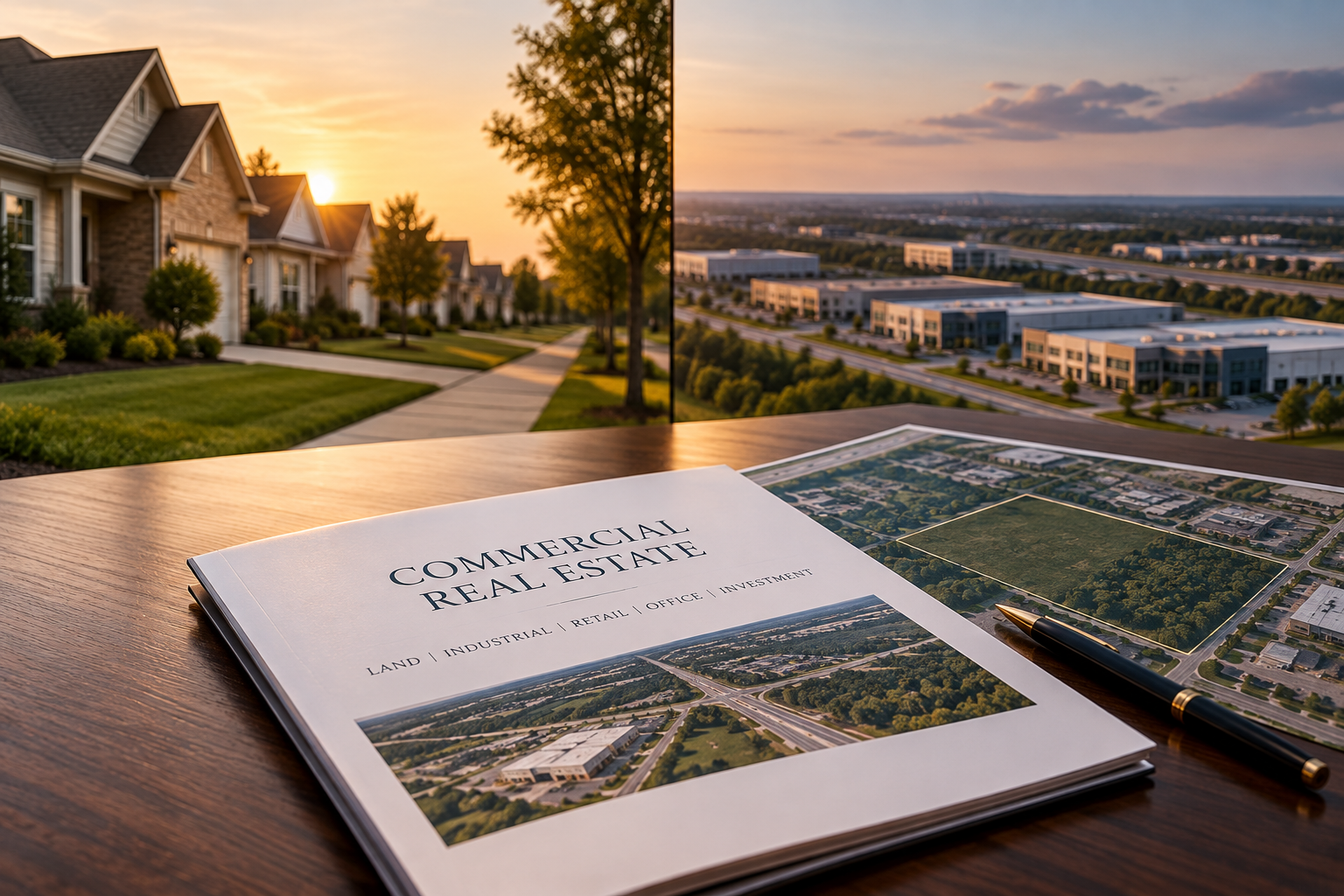
Commercial real estate has become increasingly attractive to professionals looking for opportunity outside the residential market.
That shift is not simply anecdotal. According to the National Association of REALTORS®, from 2021 to 2024 the number of members identifying both commercial and residential as their primary specialty increased by nearly 50,000. NAR has also acknowledged that lower housing inventory can push residential agents toward commercial assignments.
That is understandable.
Residential competition is intense, and commercial real estate can appear to offer larger transactions and an entirely new pool of opportunity.
But property owners need to understand one important distinction:
Commercial real estate is not residential real estate with bigger numbers.
It is a different discipline.
And when that distinction is overlooked, the person most likely to absorb the cost is the property owner.
A License Does Not Automatically Create Expertise
The same real estate license may allow an agent to work across multiple property types, but the knowledge required to properly represent those assets can be dramatically different.
Commercial real estate has its own valuation methods, buyer pools, marketing channels, financing structures, due diligence issues, and transaction timelines.
Even within commercial real estate, the disciplines vary.
Land is not industrial.
Industrial is not retail.
Retail is not multifamily.
Investment property is not owner-user property.
A vacant commercial parcel may be influenced by zoning, future land use, utilities, access, surrounding development, traffic patterns, entitlement potential, or the type of user the site can realistically support.
The property has to be understood before it can be marketed properly.
That takes more than placing the listing online.
Marketing and Positioning Are Not the Same Thing
A sign can be installed.
Photos can be taken.
A brochure can be created.
A listing can be uploaded.
None of those things necessarily mean the property has been positioned correctly.
Positioning requires understanding where the asset fits in the market and why a particular buyer should care.
The strongest selling point may not be what currently exists on the property. It may be what the property can become.
A building that does not appeal to a passive investor may be ideal for an owner-user.
A parcel that appears expensive on a per-acre basis may make sense to a developer because of access, utilities, zoning, or surrounding growth.
Those distinctions influence pricing, marketing strategy, and the buyer pool.
Without that understanding, a property can receive plenty of exposure and still be marketed incorrectly.
Visibility is not the same as strategy.
Commercial Real Estate Often Has a Long Runway
Some commercial properties sell quickly.
Many do not.
Land transactions in particular can take a year, two years, or longer to reach the right buyer at the right moment.
During that time, a commercial broker may be researching the property, developing marketing materials, paying for specialized platforms, contacting users and developers, conducting tours, answering due diligence questions, studying zoning and utilities, and repeatedly reintroducing the property to the market.
From the outside, it may appear that nothing is happening because there has not been a closing.
But commercial real estate does not always move on the seller’s preferred timeline.
A developer may like the site but be committed elsewhere.
A user may want the property but not be ready to expand.
A buyer may be waiting on financing.
The surrounding market may need more time to mature.
Sometimes the market simply is not ready yet.
That is why a long marketing period should not automatically be interpreted as poor representation.
The better question is whether the property has been positioned intelligently throughout that period.
Timing Can Distort the Story
Commercial real estate often has a much smaller buyer pool than residential.
That changes the importance of timing.
A specialized property may have a buyer universe that can practically be counted. When the right buyer finally becomes active, a transaction can happen very quickly.
This can create a misleading picture.
A commercial broker may spend years building awareness around a property, educating the market, generating conversations, and helping establish its value.
The listing expires.
Another agent takes over.
Six months later, the buyer enters the market and the property sells.
On paper, the second agent sold the property.
That does not necessarily mean the first agent failed.
Sometimes the timing finally worked.
Being in the right place at the right time should not be confused with creating the market that made the sale possible.
Winning the Listing Is the Easy Part
Competition for listings can create another problem.
The easiest way to win some property owners is to tell them exactly what they want to hear.
Yes, the property is worth that.
Yes, we can get your price.
Yes, the market will pay it.
That conversation feels good at the listing table.
It becomes much less comfortable a year later.
Commercial pricing has to be defensible.
When an asset enters the market substantially above what buyers can justify, the experienced buyers see it. Developers see it. Investors see it. Commercial brokers see it.
Eventually, the property can become known not for its opportunity, but for unrealistic expectations.
More exposure does not solve a pricing problem.
Sometimes it simply exposes the pricing problem to more people.
A Lower Commission Is Not Always a Lower Cost
Real estate commissions are negotiable, and a lower fee does not automatically mean inferior representation.
But commission should never be evaluated in isolation.
A seller who saves on a brokerage fee but loses a year because the property was improperly positioned has not necessarily saved money.
A seller who accepts an inflated listing recommendation may later face repeated price reductions and weakened market credibility.
A seller whose property is marketed to the wrong audience may never reach the buyers most capable of recognizing its value.
The true cost of representation includes more than the percentage in the listing agreement.
There is also the cost of time.
The cost of missed opportunity.
The cost of poor positioning.
And the cost of entering the market incorrectly.
The cheapest representation can become very expensive when the property is not handled correctly.
This Is Not About Residential Versus Commercial Agents
There are excellent residential professionals who successfully transition into commercial real estate.
There are also strong opportunities for residential and commercial brokers to work together.
The issue is not where an agent started.
The issue is whether the person accepting the assignment has the knowledge required to protect the client.
A professional who recognizes the limits of their experience and partners with a commercial specialist is serving the client.
A professional who invests in the education, tools, market knowledge, and relationships necessary to build a commercial practice can absolutely make that transition.
The problem begins when the seller’s property becomes the training ground.
The seller should not be funding someone else’s education with one of their largest assets.
Commercial Property Requires Commercial Strategy
A commercial listing is not simply inventory.
It may represent decades of ownership.
A family asset.
A business property.
A retirement strategy.
An estate.
A development opportunity.
A significant portion of someone’s net worth.
That deserves more than a promise to sell it.
It deserves strategy.
Sometimes that strategy produces a fast sale.
Sometimes it requires patience.
Sometimes the highest value comes from a use the seller had never considered.
And sometimes the most valuable thing a broker can tell an owner is something the owner does not particularly want to hear.
That is representation.
The Bottom Line
Winning a listing is an accomplishment.
It is not proof of expertise.
Commercial real estate is too complex, too specialized, and often too valuable to reduce representation to who promises the highest price or charges the lowest fee.
Sellers should expect their property to be understood before it is marketed.
They should expect pricing grounded in the market.
They should expect strategy, patience, market intelligence, and experience.
Because much of the value in commercial brokerage happens long before a buyer signs a contract.
It is the research.
The positioning.
The relationships.
The conversations.
The willingness to tell the truth about value.
And the experience to recognize when the market is finally ready.
Winning the listing is not the same as representing the property.
And for the seller, that difference can be worth far more than the commission.