For many business owners, the real estate beneath the business quietly becomes one of their largest assets.
They purchased the building years ago.
The mortgage was paid down.
The business grew around it.
The property appreciated.
And over time, a significant amount of capital accumulated in the real estate.
The question many owners never ask is whether that capital still needs to remain there.
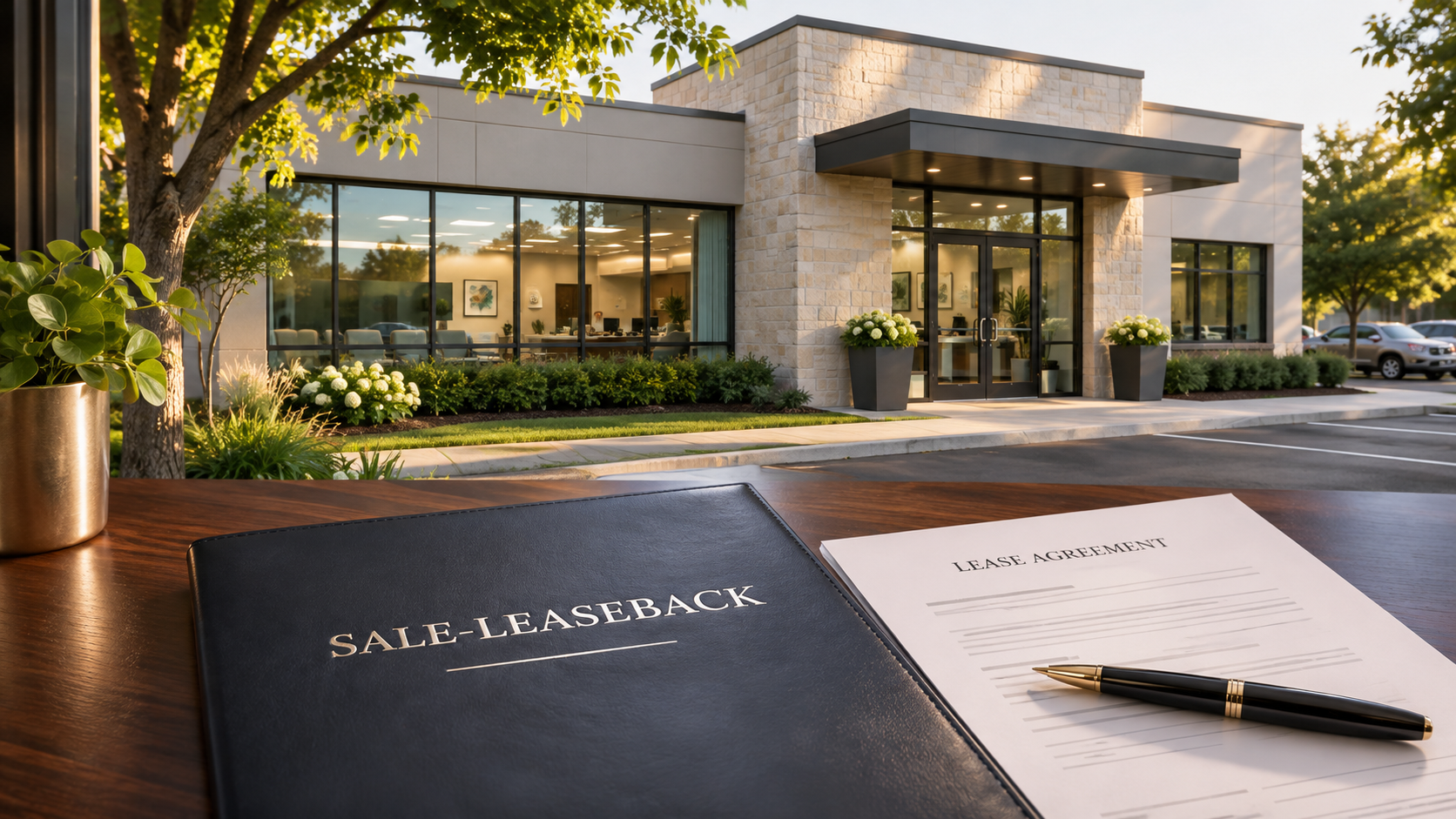
A sale-leaseback offers another option.
The owner sells the property to an investor and simultaneously leases it back, allowing the business to remain in place while converting the equity in the real estate into usable capital.
Nothing necessarily changes for the customer.
The employees stay.
The business continues operating.
The address remains the same.
What changes is the balance sheet.
And for both the business owner and the investor, that can create an entirely different kind of opportunity.
Selling the Building Does Not Have to Mean Leaving It
There is a common assumption among business owners that selling their commercial property means eventually moving the business.
A sale-leaseback breaks that connection.
Instead of selling the building vacant or relocating before a sale, the owner becomes the tenant and continues occupying the property under a newly negotiated lease.
That can be particularly valuable when the location is important to the operation.
Perhaps the business has spent years establishing itself there.
Maybe the building has specialized improvements.
The customer base knows the location.
Employees live nearby.
Moving could disrupt operations or require significant investment elsewhere.
A sale-leaseback allows the business owner to separate two decisions that are often unnecessarily tied together:
Do I still want to operate here?
and
Do I still need to own the real estate?
The answer to the first can be yes while the answer to the second is no.
Unlocking Capital That Has Been Sitting in the Building
Commercial property can be an excellent long-term investment.
But capital tied up in real estate is still capital that cannot easily be used elsewhere.
For some owners, that makes perfect sense.
For others, there may come a point when the money can work harder somewhere else.
A business may need capital for expansion.
An owner may want to reduce debt.
Equipment may need to be purchased.
A new location may be opening.
A company may be considering an acquisition.
Or an owner who has spent decades building both the business and the property may simply want greater liquidity.
A sale-leaseback converts an illiquid asset into cash without requiring the operating business to relocate.
That is why it should not necessarily be viewed simply as a real estate sale.
It can also be a capital-allocation decision.
The owner is essentially asking:
Is my highest return coming from owning this building, or could that equity create more value somewhere else?
For some companies, continued ownership is the right answer.
For others, unlocking the real estate may create opportunities that ownership cannot.
There Is Also a Succession Conversation
One of the more overlooked applications of a sale-leaseback is succession planning.
Many business owners eventually find themselves holding two significant assets:
The operating company.
And the real estate the company occupies.
Those assets do not always need to be sold together.
A future buyer may want the operating business but may not want to commit substantial additional capital to purchasing the real estate.
The current owner may want liquidity from the property before completely exiting the company.
Or the owner may want to monetize the building while continuing to operate for several more years.
A sale-leaseback can create that separation.
Instead of one large decision occurring at one moment, ownership of the real estate and ownership of the business can follow different timelines.
That can dramatically change the conversation.
Why Investors Look for These Deals
The sale-leaseback has an equally compelling side for investors.
An investor is not simply buying a building.
They are potentially purchasing a property with a tenant already in place, a newly structured lease, and income beginning immediately upon closing.
There is no initial vacancy to fill.
No immediate leasing campaign.
No waiting for rent to begin.
For the right investor, that predictability can be extremely attractive.
But the investor is evaluating more than the real estate.
They are also evaluating the business occupying it.
How essential is the location to the company?
How durable is the business?
Does the property support the tenant's long-term needs?
And would the real estate still have value to another user if the tenant eventually left?
A strong sale-leaseback combines two desirable characteristics:
A tenant the investor wants today and real estate the investor would still want tomorrow.
When both are present, the transaction becomes much more compelling.
The Lease Can Change the Value of the Property
This is where sale-leasebacks become particularly interesting.
The sale and the lease cannot really be evaluated separately.
They influence one another.
A longer lease may create more predictable income for an investor.
A strong tenant may reduce perceived risk.
Rent increases can create future income growth.
A net lease structure may shift certain property expenses to the tenant.
All of those characteristics can influence what an investor is willing to pay.
But there has to be balance.
An owner naturally wants the strongest possible sale price while also wanting manageable rent.
The investor needs an acceptable return on the capital being invested.
Those objectives eventually have to meet.
The rent supports the value, and the value influences the rent.
Artificially increasing rent simply to justify a higher sale price can create problems later.
The business still has to comfortably support the lease.
The investor still has to believe the rent is sustainable.
And the underlying property still needs to make sense if it eventually returns to the broader leasing market.
The strongest sale-leasebacks are not engineered simply to maximize one number at closing.
They are structured so the economics continue to make sense after closing.
The Investor Is Buying Income, but Also Risk
The presence of a tenant does not automatically make a sale-leaseback a strong investment.
The quality of that income matters.
A building occupied by an established, profitable business in a strong location presents a very different investment profile from a highly specialized property occupied by a struggling company.
That is why investors evaluate the tenant and the property together.
In some transactions, the tenant may be the primary attraction.
In others, the underlying real estate may be strong enough that an investor remains comfortable regardless of what happens at the end of the lease.
The strongest opportunities often provide both:
Reliable income today.
Real estate with a future tomorrow.
The Market Is Already Showing Us Where the Capital Is Going
Sale-leasebacks are not an obscure financing strategy being used only in unusual circumstances.
The broader net-lease market is attracting substantial investment capital.
According to CBRE's Q2 2026 U.S. Net Lease Investment Figures, net-lease investment volume increased 13% year over year during the quarter to $12.8 billion. For the 12 months ending in Q2, investment reached $57 billion — a 14% increase from the prior year.
Recent transactions also demonstrate how major owner-occupiers are using the structure.
In September 2026, JLL arranged a $91.7 million sale-leaseback involving 34 Trustmark Bank properties across the Southeast. Trustmark remained in the properties under a 15-year absolute triple-net master lease while converting the real estate into capital that could be deployed elsewhere in the business.
The scale of that transaction is different from what many private business owners may contemplate, but the strategy is remarkably similar.
An operating company owns valuable real estate.
An investor wants long-term income.
The company wants access to the equity sitting inside the property without disrupting operations.
A sale-leaseback connects those interests.
That is why the structure deserves attention from businesses of many different sizes.
Ownership Carries Its Own Capital Requirements
Owning commercial real estate involves more than making a mortgage payment.
Buildings age.
Roofs eventually need replacement.
Parking lots deteriorate.
Major systems require capital.
Insurance changes.
Property needs evolve.
Depending on how a sale and lease are structured, the business owner may be able to shift some of the long-term real estate investment burden while focusing more capital and attention on the operating company.
That does not mean every obligation disappears.
In a net lease, the tenant may still retain significant responsibility for the property.
A sale-leaseback does not eliminate obligations.
It changes them.
The owner moves from being both business operator and property owner to becoming a tenant with clearly defined contractual rights and responsibilities.
For some businesses, that can be a much better use of capital.
It Is Not Free Money
There is also an important tradeoff.
The owner gives something up.
The real estate is no longer theirs.
Future appreciation belongs to the investor.
The business now has a lease obligation.
The owner no longer has unlimited control over the property.
And decisions that once belonged entirely to the owner become governed by the lease.
There may also be significant tax and financial consequences associated with the sale.
That is why sale-leasebacks require coordination among commercial real estate professionals, attorneys, accountants, lenders, and financial advisors.
The value comes from structuring the transaction correctly, not simply from selling the building.
Why the Conversation Matters Now
Today's commercial real estate environment makes this strategy particularly relevant.
Business owners are paying closer attention to liquidity, financing costs, and where their capital is producing the best return.
At the same time, investors continue to seek predictable income-producing real estate with durable tenancy.
One side has equity tied up in a physical asset.
The other has capital looking for income.
A sale-leaseback can connect the two.
That does not mean every owner-occupied commercial building should be sold.
Some businesses benefit enormously from controlling their real estate.
But owners who have accumulated substantial equity may be overlooking an asset that can do more than simply house the company.
The building itself may have become a source of capital.
The Bottom Line
A sale-leaseback changes the way a business owner looks at commercial real estate.
Instead of asking:
“Should I sell my building?”
the better question may be:
“Does my business still need to own the building?”
Those are not the same question.
For the owner, a sale-leaseback can unlock equity, preserve the operating location, increase liquidity, support expansion, reduce debt, or become part of a larger succession strategy.
For the investor, it can create immediate income backed by an established tenant and an asset with long-term real estate value.
And when both sides are aligned, the transaction can accomplish something a conventional sale cannot.
The owner monetizes the real estate without moving the business.
The investor acquires the property without searching for a tenant.
The business keeps operating.
The capital starts working somewhere else.
Sometimes the most valuable thing a business owner can do with their commercial property is not continue owning it.
Sometimes the value is in selling the real estate while keeping everything else exactly where it is.